CT-Guided Brachytherapy:
Dr. Doggett’s 30-Year Legacy of Targeted,
One-Session, Out-Patient Cancer Treatment.
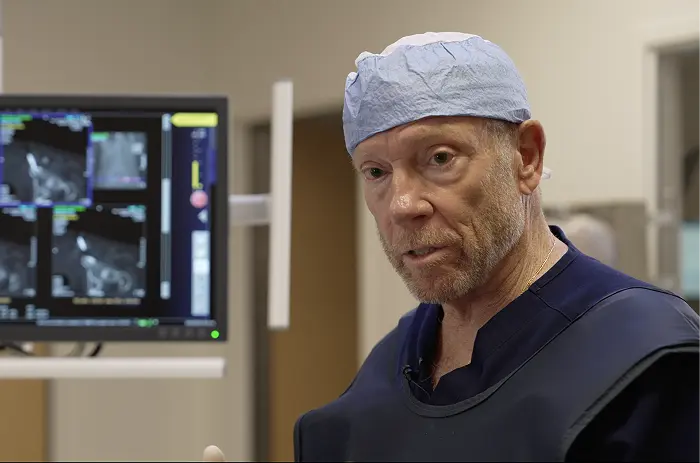
Patients from around the world continue to seek Dr. Doggett’s expertise in CT-guided brachytherapy, particularly for advanced cancers often considered untreatable by other physicians.
Brachytherapy is a form of radiation therapy in which sealed radioactive sources are placed directly inside or very close to a tumor.
This targeted approach allows a high dose of radiation to be delivered to cancerous tissue while minimizing exposure to surrounding healthy structures. The term comes from the Greek word brachys, meaning "short"; referring to the short distance between the radiation source and the treatment site. Because the radiation acts locally, brachytherapy is highly effective with one treatment session and minimal side effects compared to external beam techniques which require daily treatment visits for weeks and have significant side effects.
The origins of brachytherapy date back to the early 1900s, shortly after the discovery of radium by Marie and Pierre Curie, when physicians began placing small amounts of radium directly into tumors. Over the decades, advances in radiation physics, imaging, and safety have transformed brachytherapy into a precise, well-regulated treatment. Today, it is used for a variety of cancers at every site in the body. Modern brachytherapy employs miniature, carefully calibrated radioactive seeds, often guided by ultrasound, CT, or MRI, to optimize placement and achieve the best possible outcomes.
For the past 30 years, Dr. Doggett has refined his technique of implanting tiny radioactive seeds directly into tumors using continuous CT scan guidance.
The procedure is performed under anesthesia, with the patient asleep, and completed in a single outpatient session. His results have been extensively published in peer-reviewed scientific journals.